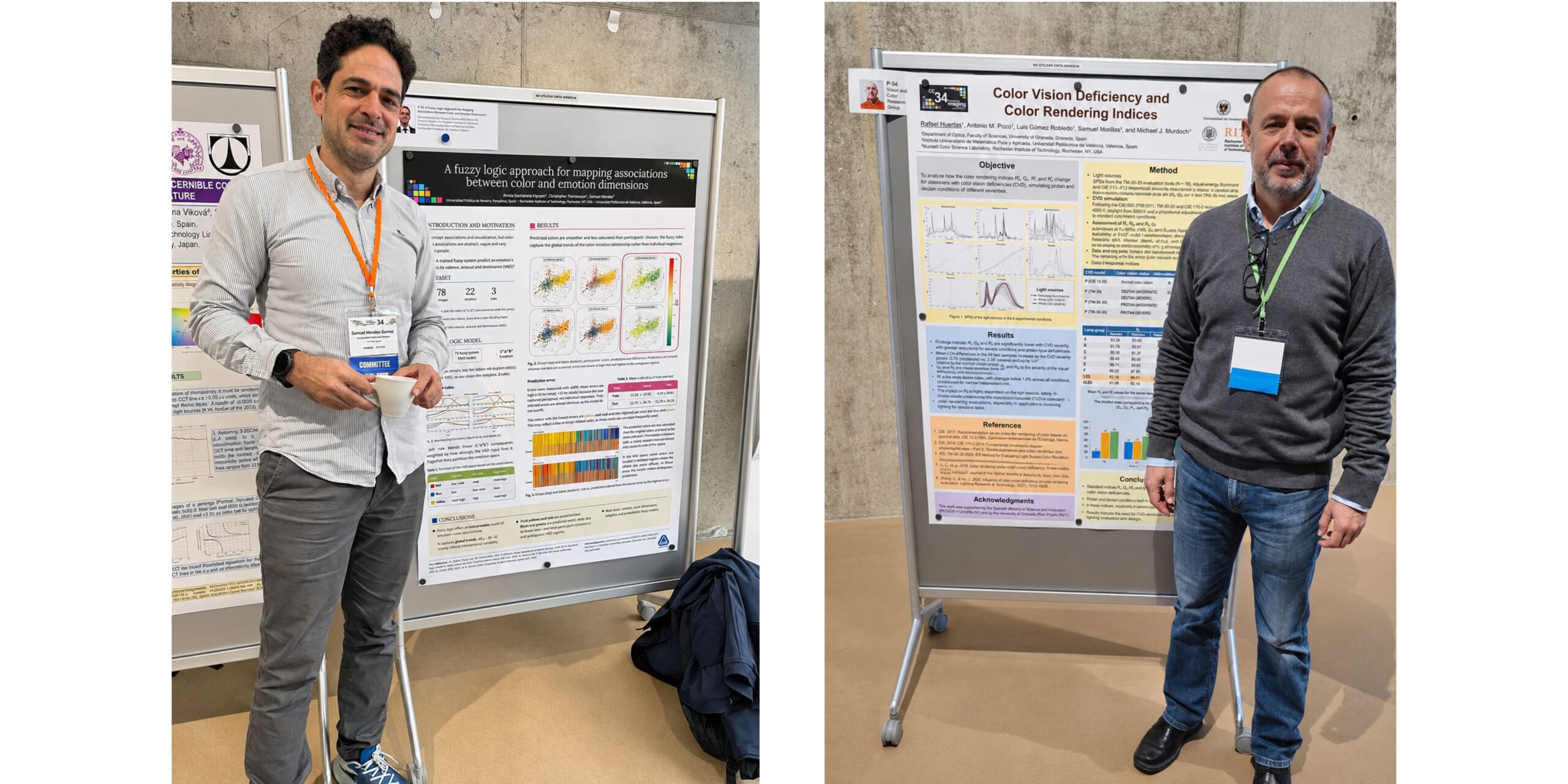
Our colleagues Samuel Morillas and Rafael Huertas participated in the 34th edition of the Color and Imaging Conference (CIC 2026), held from November 2–6 in Barcelona. This international scientific conference brings together specialists in color science, visual perception, image processing, and color reproduction technologies.
During the conference, both researchers presented their work, addressing different challenges related to human color perception.
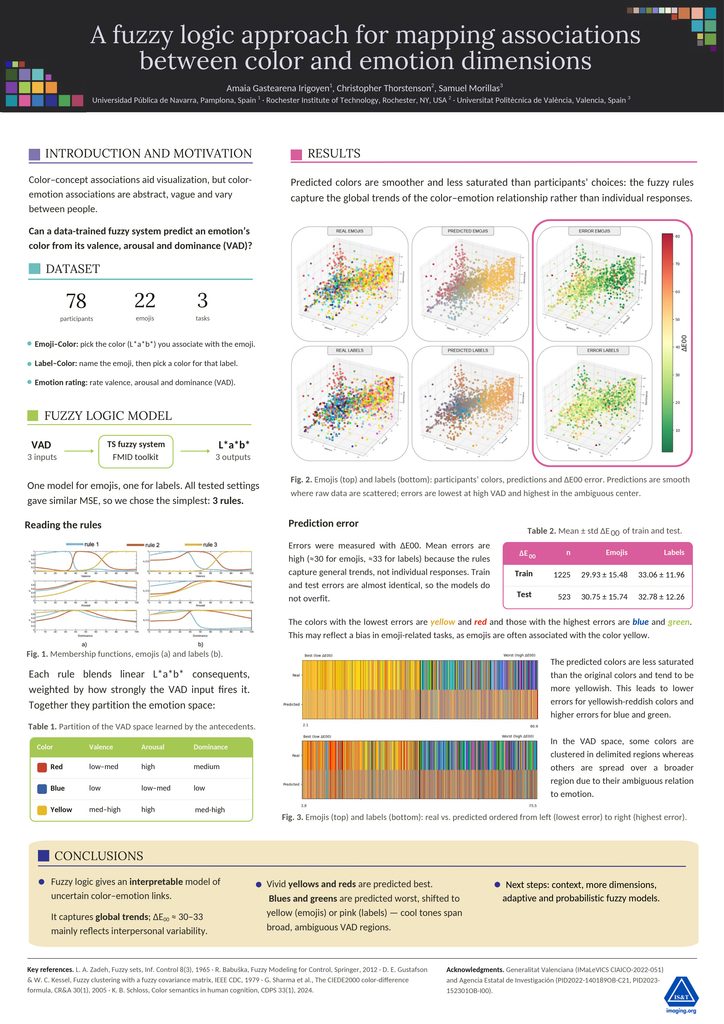
- Samuel Morillas | A fuzzy logic approach for mapping associations between color and emotion dimensions
Is it possible to predict which colors we associate with different emotions?
This research, developed in collaboration with the Public University of Navarre and the Rochester Institute of Technology, proposes a computational model based on fuzzy logic to study and predict associations between colors and emotions.
Using experimental data from 78 participants, the system relates colors to three emotional dimensions. The results show that the model can identify general patterns, although significant differences exist between individuals. This research contributes to the development of interpretable models that help us better understand the relationship between visual perception and emotions.
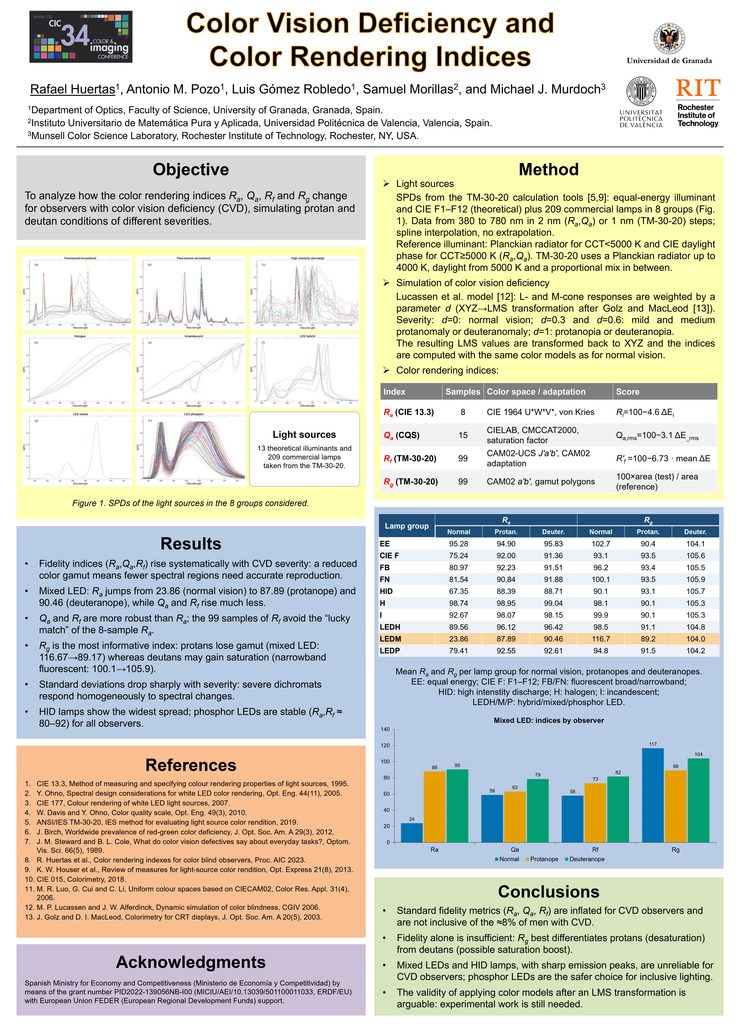
- Rafael Huertas | Color Vision Deficiency and Color Rendering Indices
Are we accurately evaluating the color rendering quality of a light source when not everyone perceives colors in the same way?
This research, conducted in collaboration with researchers from the University of Granada, the Universitat Politècnica de València, and the Rochester Institute of Technology, examines how color vision deficiencies affect the indices used to evaluate the color rendering of different light sources.
The results reveal that traditional color fidelity indices may yield high scores for individuals with color vision deficiencies without adequately reflecting differences in their perception. Furthermore, the findings highlight the importance of considering changes in the perceived color gamut and developing more inclusive evaluation criteria.
Both studies reinforce VIPLab’s commitment to investigating human visual perception and developing computational models to better understand, analyze, and evaluate color, contributing to advances in color science and its real-world applications.
You can find more information about both studies in the posters shared with this post:
Samuel Morillas | A fuzzy logic approach for mapping associations between color and emotion dimensions
Rafael Huertas | Color Vision Deficiency and Color Rendering Indices