

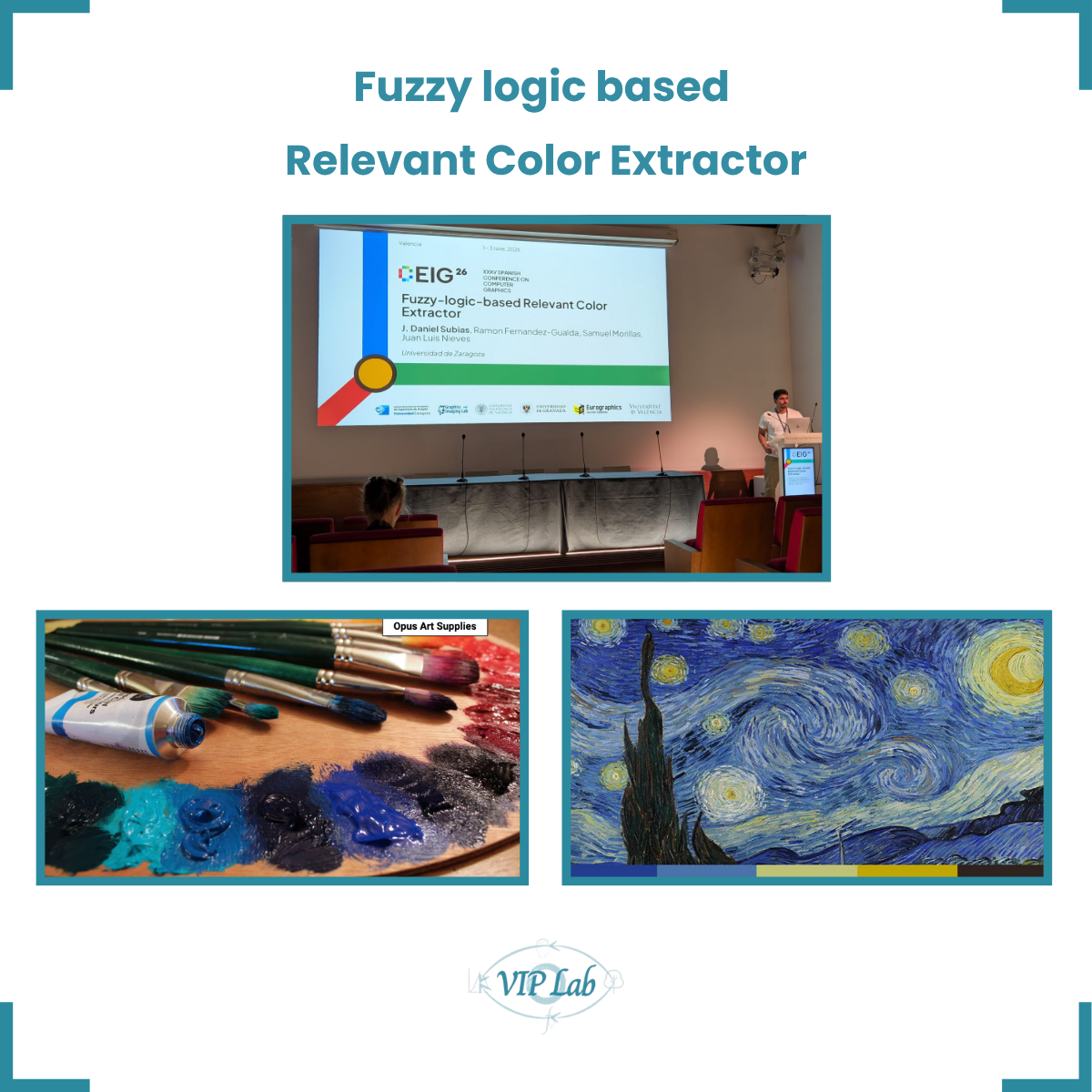
Our colleague Daniel Subías participated in the 35th Spanish Conference on Computer Graphics (CEIG 2026), held from June 1–3 in Valencia, one of the leading national scientific conferences in the field of computer graphics in Spain.
During the conference, he presented the paper “Fuzzy-logic-based Relevant Color Extractor”, a collaborative work developed with researchers from the Universidad de Zaragoza, Universidad de Granada, and Universitat Politècnica de València, as part of the IMaLeVICS project (Interpretable Machine Learning for Imaging and Vision Sciences).
The research addresses a fundamental challenge in the computational analysis of artworks: how can we automatically extract a color palette that reflects the most relevant colors of a painting from the perspective of human perception?
To tackle this problem, the proposed method employs fuzzy logic and integrates three key perceptual color attributes: luminance, chromaticity, and local color redundancy. Based on these properties, the system identifies the most significant colors in a painting and generates adaptive palettes tailored to the specific characteristics of each artwork.
The results, validated on a large dataset of artworks and compared with human annotations from the Museo Nacional del Prado, show a high degree of agreement with human visual perception. Furthermore, the project introduces a new color-distance-based metric that enables a more rigorous evaluation of palette similarity.
Among the main contributions of this research are:
- A set of linguistic rules to model color saliency in paintings.
- A color palette extractor not limited by a fixed number of colors and can adapt to the chromatic complexity of each artwork.
- A new metric for measuring color palette alignment with human perception.
This work reinforces IMaLeVICS line of research, which focuses on understanding how the human visual system perceives digital images, through the development of computational models inspired by visual perception that contribute to improving visual quality and image processing in real-world applications.